跳至主要内容

Reduce the Deformation of Sheet Metal Welding With the Help of External Force


sheet metal china | sheet metal fabrication china1 Water Cooling Block

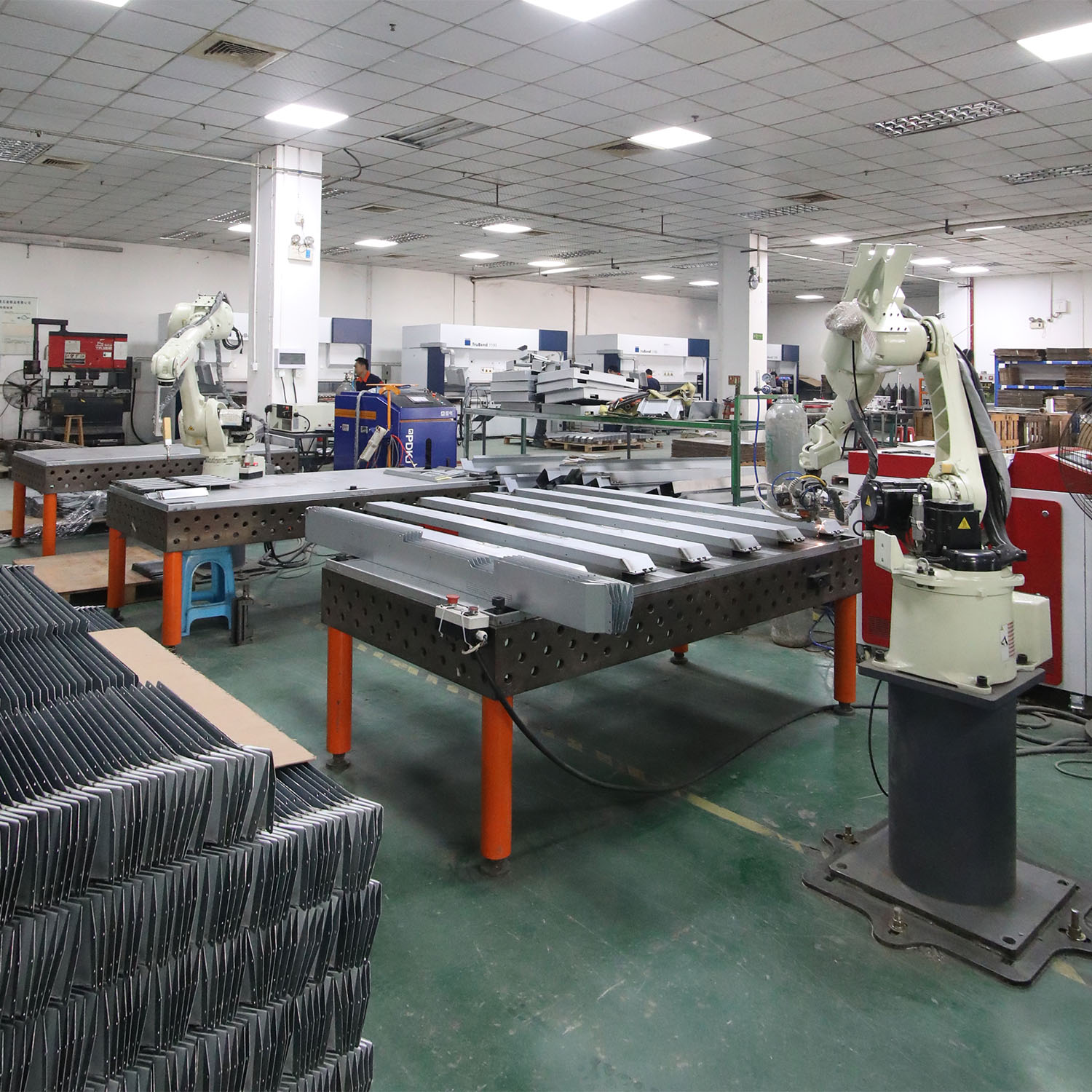
Many techniques can be used to control the welding deformation of special welding workpieces. For example, in thin plate welding, the use of water-cooled blocks can take away the heat of the welded workpiece. The copper pipe is welded to the copper fixture by brazing or tin welding, and the circulating cooling is carried out through the water pipe to reduce the welding deformation.

2 Wedge Block Locating Plate

“Locating plate” is an effective technology to control welding deformation during butt welding of steel plate, as shown in the figure. One end of the positioning plate is welded on a plate of the workpiece, and the other end wedges the wedge block into the pressing plate. Multiple positioning plates can even be arranged to maintain the positioning and fixation of the welded steel plate during welding.

3 Thermal Stress Relief

Except for special cases, it is not a correct method to eliminate stress by heating. Welding deformation shall be prevented or reduced before the completion of workpiece welding. click here to contact JIATONG

QUICK LINKS:>>>Sheet Metal Frame | Sheet Metal Housing | Sheet Metal Chassis | Sheet Metal Cover | Sheet Metal Parts Components | China Sheet Metal Manufacturer | Custom Sheet Metal Parts | Sheet Metal Cabinet | China Sheet Metal Parts | Sheet Metal Bracket | Sheet Metal Parts Manufacturer | Custom Electrical Enclosures | China Sheet Metal Fabrication | China Metal Parts Manufacturer | Order Custom Metal Parts | Custom Machined Metal Parts | Sheet Metal Fabrication China | Metal Manufacturing in China | Metal Enclosure Manufacturers | Sheet Metal Cover | Sheet Metai China

评论

此博客中的热门博文

Process Analysis of Sheet Metal Structure Design

  Sheet metal processing is a comprehensive cold working process for sheet metal, including shearing, punching, cutting, folding, welding, riveting, etc. its remarkable feature is that the thickness of the same part is the same.   Sheet metal is generally some sheet metal through manual or die stamping to produce plastic deformation to form the desired shape and size, and can further form more complex parts through welding or a small amount of machining. For example, chimneys, iron buckets, oil tanks, oil pots, ventilation pipes, funnel-shaped, etc. commonly used in families, as well as electrical cabinets, shells of various special equipment, computer cases, automobile shells, etc., are all sheet metal parts.   There are no specific structural requirements for sheet metal parts, which are generally designed according to the needs of products. On the premise of meeting the functions of products, the designed structure should be easy to process, low cost and beautiful. For...

Four Basic Cold Processing Links to Optimize Sheet Metal Design

  Generally, sheet metal parts have obvious advantages in strength, weight and cost, and have better point-to-point performance than traditional parts. Therefore, up to now, sheet metal parts have been gradually applied in China’s high-tech fields such as electronics and communication. At the same time, people have gradually put forward higher requirements for the quality and function of sheet metal parts, The proper optimization of the original sheet metal processing technology has become the focus of sheet metal processing personnel. According to the actual research, this paper believes that the optimization of processing technology should be carried out one by one from the application of four basic cold processing links of sheet metal processing. 1  Blanking    First of all, as far as the blanking link is concerned, generally speaking, blanking refers to the separation of sheet metal materials through the stamping of the die, so as to realize the separation of she...

CNC Sheet Metal Bracket

  Brackets can be manufactured in various ways, such as casting or CNC machining. However, the best way to make simple supports is sheet metal. One of the most common sheet metal processes is bending, in which a machine called a brake is used to bend the sheet metal to a maximum angle of 120 °. This is probably the most important process when manufacturing sheet metal supports, because almost all supports contain at least one bend. Other sheet metal processes must also be used. Before any bending, the sheet metal must be cut to a certain size by using a machine such as a laser cutter or a plasma cutter. You can use a punch to punch holes in the bracket (for screws), and you may need to weld to add gusset plates or other features. In addition to the above sheet metal process, CNC machining can also be used to add more complex features to the support, especially for customized design of non-standard parts.   The support can be made of a variety of metals, depending on certain fa...